
Algorithms and Handprints: The New Era of Digital Craftsmanship and Technological Archaeology

Throughout the history of design, "craft" has been the practice of understanding, mastering, and imbuing material with its spirit. It is no coincidence that in ancient Greece, art and craft were expressed with the same word ( techne ). In the 19th century , the Arts and Crafts movement, spearheaded by William Morris, emerged as a counterpoint to the uniform mass production of the Industrial Revolution, advocating for the integrity of materials and the "trace of the producing hand," seeking to restore the lost aura to objects. As time progressed, potter's wheels and carving chisels gave way to the tools of the new era. At the dawn of the digital age, 3D modeling specialists and digital sculptors began shaping pixels and polygons in the virtual space behind screens. A mouse click or a precise stroke of a stylus on a Wacom tablet transformed the digital world into a new form of craftsmanship.
But today, this relationship between human hands and computer interfaces is opening the doors to a whole new and multifaceted universe. At Formasupra, our vision of "digital craftsmanship" takes shape precisely at the intersection of this rich history and modern algorithms.
From 2023 to the Present: A Practice of "Technological Archaeology"
The integration of artificial intelligence into design was a disruptive revolution rather than a smooth transition. For us, this exploration began with our first experiments with text-to-3D tools at our Rest in Pieces exhibition in 2023. At the time, these tools were far from perfect; they produced algorithmic hallucinations and unexpected mutations. However, when founding Formasupra, we decided not to hide these "flaws" and the initial, raw reflexes of AI, but rather to physically record them.
For us, this process is a kind of technological archaeology practiced for the future. The forms we obtain by pushing the boundaries and capabilities of artificial intelligence are not merely design objects; they are frozen, collectible evidence of the technological breakthrough of the mid-2020s. And at Formasupra, we will continue to test these tools with each new update of the algorithms, expanding this archive with new series.

The Collaborative Work of Humans and Machines
The concept of "Digital Craft" is not simply about writing a command and printing it out. No matter how advanced the algorithms involved, the entire process, from beginning to end, involves significant human labor and curation. This includes optimizing the form digitally, translating it into the language of 3D printing (G-code), meticulously considering everything from layer thickness to wall/infill architecture, and finally, the care given to the final product after printing.
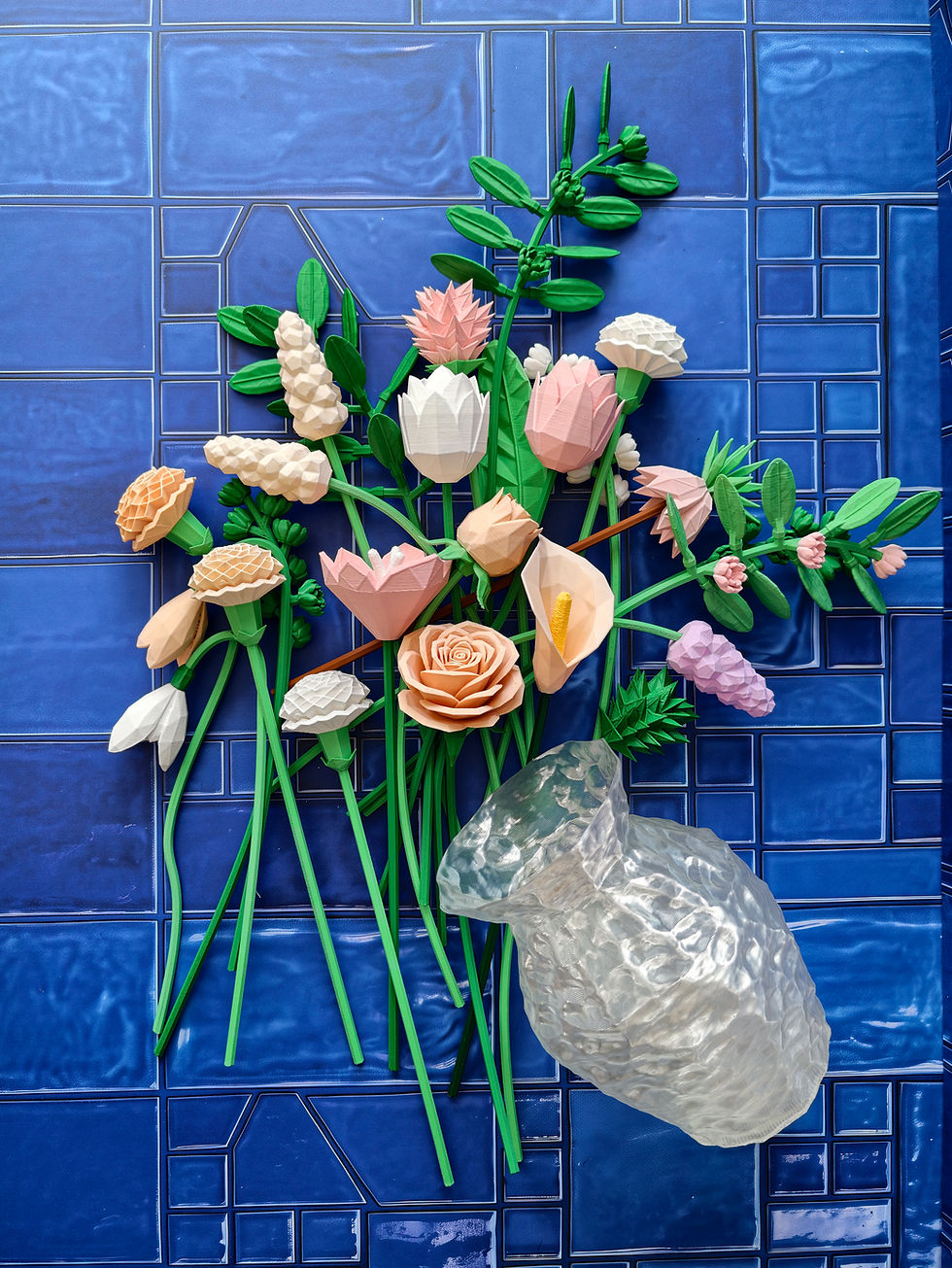
This meticulous production philosophy is applied with the same standard in a delicate bookmark we produce using bioplastic (PLA), in a digitally modeled flower form, or in a sculptural accent object. Each piece from Formasupra is a synthesis of the perfection of the digital world and the human-centered nature of physical production.

Objects of Accent as Spatial Expressions
Our designs navigate the boundaries of traditional furniture categories. Inspired by the colossal sculpted stones of Anatolia that have defied history and the monumental silhouettes of Mesopotamia, our designs such as Kaya, Sur , and Kozalak , while resembling simple coffee tables or pedestals at first glance, are actually powerful "accent objects" that define the character of a space.
Produced without paint, supports, and entirely with natural layered traces, these forms go beyond function, making a visual statement in the space. In an architect's or designer's spatial arrangement, they are positioned not as standard functional objects, but as sculptural focal points that blend the dignified monumentality of the past with the digital production techniques of the future.


Comments